Where to See Orcas Near Vancouver
Where to find orcas near Vancouver: Salish Sea, Gulf Islands, Howe Sound. Resident vs Bigg's transients, BC marine-mammal rules, best departure points.
Vancouver is one of the best orca-watching cities in the world — but the orcas themselves don’t sit in any one spot. They move around the Salish Sea following prey, and the question “where do I see them?” is really three questions in one: which body of water, which time of year, and which kind of orca. This guide answers all three.
For the seasonal half of the answer, see best time for Vancouver whale watching. This page focuses on the geography and the species, so you know what to look for when the covered catamaran from Granville Island heads out onto the water.
The Salish Sea — Vancouver’s Orca Habitat
The Salish Sea is the umbrella name for the inland marine waters shared by southern British Columbia and Washington State. It includes three main basins:
| Basin | Location | Orca presence |
|---|---|---|
| Strait of Georgia | Between mainland BC and Vancouver Island; includes the Gulf Islands | Both resident and Bigg’s; primary Vancouver whale-watching grounds |
| Haro Strait / Boundary Pass | Between Gulf Islands and San Juan Islands | Classic Southern Resident summer territory |
| Strait of Juan de Fuca | South of Vancouver Island, opens to Pacific | Migration corridor; greys pass through; Bigg’s year-round |
The covered catamaran from Granville Island typically cruises south and west into the Strait of Georgia, working the waters around the Gulf Islands and sometimes pushing toward the San Juan Islands or up into Howe Sound, depending on where the day’s sightings are. The captain follows the operator radio network — when one of the dozen-plus Pacific Whale Watch Association (PWWA) member boats spots whales, every other boat hears the location immediately.
Two Orcas, Two Stories
This is the most important thing to understand if you want orca sightings near Vancouver: there are two completely different kinds of orca in these waters, and they behave nothing alike.
Southern Resident Orcas (J, K and L pods)
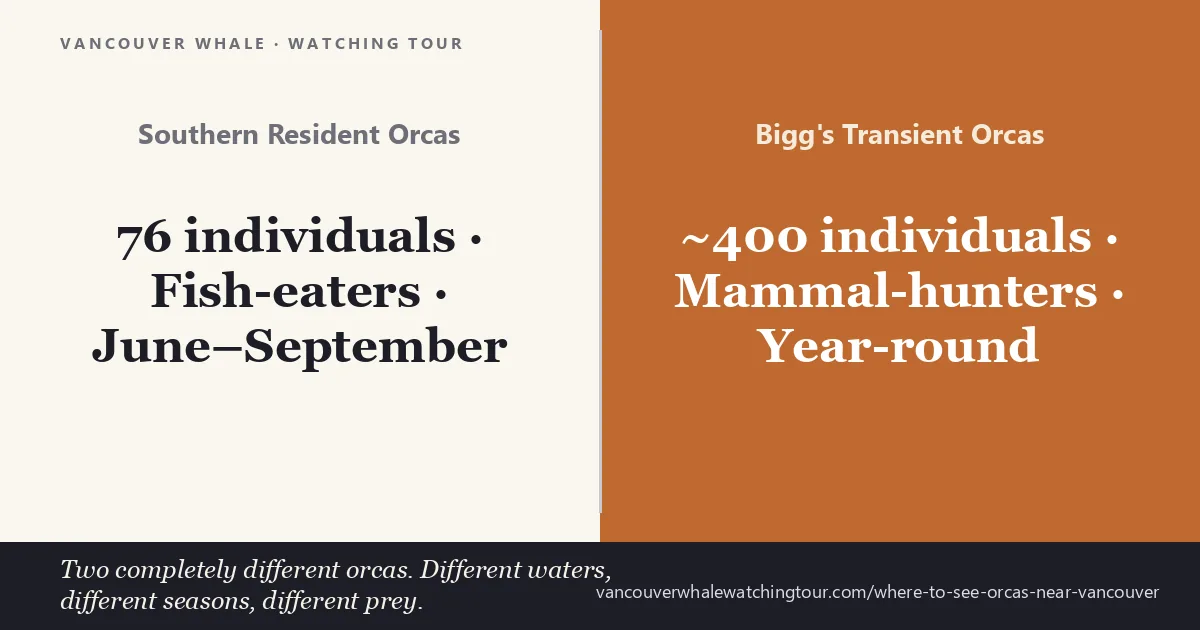
The famous ones. 76 individuals across three pods (J ~27, K ~15, L ~34) as of May 2026, tracked individually by name and ID since the 1970s. The oldest known living SRKW is L25 “Ocean Sun” — estimated born 1928 (~98 years old), still travelling with the L11s. They are:
- Fish-eaters — almost exclusively Chinook salmon
- Highly social — travel in tight family groups (pods)
- Endangered — federally listed in both Canada and the US
- Seasonal in Vancouver waters — they follow Chinook salmon runs and are most reliably present in the Salish Sea June through September
- Subject to the strictest protections — under DFO’s current 2025–2026 Interim Order all boats must stay 400m from any killer whale through May 31, 2026; from June 1, 2026 the Southern-Resident buffer jumps to 1,000m
When people talk about “Vancouver’s orcas” in the iconic Free-Willy sense, they mean Southern Residents. The summer-only window is what makes June–September the prime orca-watching season.
Bigg’s (Transient) Orcas
The opposite of the residents in almost every way:
- Mammal-eaters — they hunt harbour seals, porpoises, sea lions, occasionally smaller whales
- Smaller groups — typically 2–6 individuals, less social structure
- Healthy and growing population — not endangered; the coastal Bigg’s population is now estimated at roughly 400 individuals, and 2025 broke records for unique Salish Sea sightings (PWWA / Orca Behavior Institute data)
- Year-round residents of the Salish Sea
- Killer-whale approach rules apply — the 400m minimum approach distance covers Bigg’s through May 31, 2026; on June 1, 2026 the legal Bigg’s-specific minimum reverts to 200m, though PWWA operators voluntarily keep a 400m buffer
If your trip is in April, May, October, or any non-peak month and you see orcas — they are most likely Bigg’s transients. The boom in Bigg’s sightings over the last decade is one reason Vancouver whale watching season has effectively expanded.
Where Each Species Tends to Hang Out
Gulf Islands and Strait of Georgia
The primary Vancouver whale-watching grounds. Both Southern Residents (summer) and Bigg’s transients (year-round) hunt these waters. The big herring spawn in spring and Chinook salmon runs in summer concentrate prey, and the orcas follow. This is where the catamaran spends most of its time.
You’ll see: Both orca types in season; humpbacks June–October; harbour porpoises and Dall’s porpoises year-round; Steller and California sea lions (especially at known haul-outs); bald eagles overhead.
Haro Strait / Boundary Pass
The boundary waters between the Canadian Gulf Islands and the American San Juan Islands. Historically the most reliable Southern Resident territory in the entire Salish Sea — this is where the long-running San Juan-side whale watching industry has tracked them for decades. The Vancouver catamaran works the Canadian side; sightings here are common in peak summer.
Howe Sound
Just north of Vancouver. Howe Sound is a different animal — a fjord-like inlet famous for scenery, Bowen Island, and resident pods of Steller sea lions, harbour seals, and bald eagles. Orca sightings here are no longer just incidental — specific Bigg’s matrilines now hunt the sound’s sheltered waters for nearshore seals, and field observers report Howe Sound has transitioned from an “occasional” site to a consistent hunting hotspot in recent years. Total sighting volume is still lower than the Strait of Georgia, but the inlet has become a credible bonus zone when the catamaran turns north.
Strait of Juan de Fuca
The big-water corridor connecting the Salish Sea to the open Pacific. Migration route for grey whales (spring north / fall south) and a year-round Bigg’s transient highway. Vancouver-based tours rarely reach this far south — it’s more typically worked by Victoria-departing operators. If you’re basing yourself across the water, see our full guide to whale watching on Vancouver Island, which covers Victoria, Telegraph Cove, and Tofino.
Where to Depart From
| Departure point | Operator examples | Pros | Cons |
|---|---|---|---|
| Granville Island, Vancouver | Prince of Whales (covered catamaran), Wild Whales Vancouver (zodiacs) | Easy access from downtown Vancouver, full Salish Sea coverage | 5h trip on catamaran |
| Steveston, Richmond | Vancouver Whale Watch | Closer to Fraser River salmon run grounds | Requires getting out to Richmond |
| Victoria’s Inner Harbour / Fisherman’s Wharf | Prince of Whales (Inner Harbour), Eagle Wing (Fisherman’s Wharf) | Closest to Haro Strait Southern Resident territory | Requires getting to Victoria first |
Most Vancouver visitors take the Granville Island catamaran — it’s the most-reviewed option (2,362+ reviews, 4.8/5) and the easiest logistically. If you’re already on Vancouver Island, departing from Victoria gets you to the Southern Resident core territory faster. The seaplane combo that pairs a Vancouver-to-Victoria flight with a Victoria-based whale-watching trip exists if you want the best-of-both.
The Rules — How Close Can You Actually Get?
Canadian federal Marine Mammal Regulations and the annually-renewed Southern BC Interim Order set the legal minimum approach distances. Critically, the regime is changing on June 1, 2026:
| Species | Until May 31, 2026 | From June 1, 2026 |
|---|---|---|
| Southern Resident orcas | 400m | 1,000m |
| Bigg’s (transient) orcas | 400m | 200m (PWWA members voluntarily keep 400m) |
| Humpbacks, minke, grey whales | 100m (200m if resting/with calf) | Same |
| Unidentified ecotype | 400m | DFO advises assume 1,000m |
Other constants: no chasing, no sudden engine restarts, max 30 minutes parked viewing per group. Penalties run to $1,000,000 in fines. These rules are enforced by Fisheries and Oceans Canada (DFO).
On top of the legal minimum, PWWA member operators (which include all the Vancouver-area boats discussed above) follow voluntary best-practice protocols: a 7-knot speed limit within 1 km of any whale, a yellow “Whale Warning Flag” flown to alert other boaters of a nearby sighting, and an active no-go policy around Southern Residents that effectively maintains the 1,000m buffer year-round.
This means you won’t be a few meters from an orca. But binoculars get you close enough to see dorsal fins, breaches, and tail flukes clearly — and that’s exactly the experience visitors come away from.
Reporting a Sighting — Citizen Science
If you spot a cetacean — on a tour, from a ferry, from shore — Ocean Wise’s BC Cetacean Sightings Network wants the data. Public reports go to wildwhales.org or the free WhaleReport app (iOS / Android). Pro-mariner reports trigger the WhaleReport Alert System (WRAS), which automatically alerts the bridges of ferries, freighters, and tugs within 10 nautical miles so they can slow down or alter course. It’s a small thing tourists can do that directly reduces vessel-strike risk.
Coast Salish Stewardship of These Waters
The Salish Sea waters where Vancouver whale watching happens — Burrard Inlet, English Bay, Howe Sound (Átl’ka7tsem), the Strait of Georgia — are the unceded ancestral territories of the xʷməθkʷəy̓əm (Musqueam), Sḵwx̱wú7mesh (Squamish), and səlilwətaɬ (Tsleil-Waututh) Nations. The Fraser River mouth — central to the Chinook runs that SRKWs depend on — is within sc̓əwaθən (Tsawwassen) territory. The Musqueam term for orca, q̓əlɬaləməcən, is often translated as “blackfish” or “orca” in hən̓q̓əmin̓əm̓; the related Lummi word qwe lhol mechen (“our relations under the water”) reflects a long Coast Salish framing of orcas as kin rather than resource.
Several nations co-lead current SRKW recovery work with DFO Canada — the Tsleil-Waututh Burrard Inlet Action Plan, the Squamish River Chinook habitat restoration, the W̱SÁNEĆ QENTOL,YEN Marine Guardians acoustic-monitoring program, and the Indigenous Multi-Nation Group that co-developed the June 2026 management measures above. Knowing whose waters you’re a guest in is part of going out responsibly.
What Else You’ll See (Besides Orcas)
Even on a quiet orca day, the Salish Sea is alive with marine wildlife:
- Humpback whales (June–October peak)
- Minke whales (occasional)
- Grey whales (during spring/fall migration)
- Steller and California sea lions (year-round at haul-outs)
- Harbour seals
- Harbour porpoises and Dall’s porpoises (year-round)
- Bald eagles
- Many seabirds — cormorants, gulls, scoters, mergansers, oystercatchers
The peak-season sightings guarantee on the covered catamaran from Granville Island is specifically for whales — orcas, humpbacks, greys, or minke. If you don’t see one, you can rebook a later sailing for free.
Ready to Book?
The covered catamaran from Granville Island covers the full Vancouver Salish Sea orca territory — Strait of Georgia, Gulf Islands, and into Haro Strait when sightings call for it. 2,362+ guests rated it 4.8/5. Five hours, three viewing levels, naturalist crew, free professional photo package, sightings guarantee — from $186 per person, free cancellation up to 24 hours before. Check availability and book →
Plan Your Trip
Browse Vancouver & Island Whale Tours
Live availability across Vancouver, Victoria and Vancouver Island — instant confirmation and free cancellation.
Spot Orcas in the Salish Sea — Free Photos Included
Join 2,362+ guests who rated this Vancouver whale watching tour 4.8/5. Five hours on a covered Salish-Sea catamaran, three viewing decks, certified naturalist crew, free professional photo package — and free cancellation up to 24 hours before departure.
Check Availability & Book