What to Bring on a Vancouver Whale Watching Tour
Complete packing list for Vancouver whale watching: layers, what to wear on catamarans vs zodiacs, photo gear, kids, seasickness.
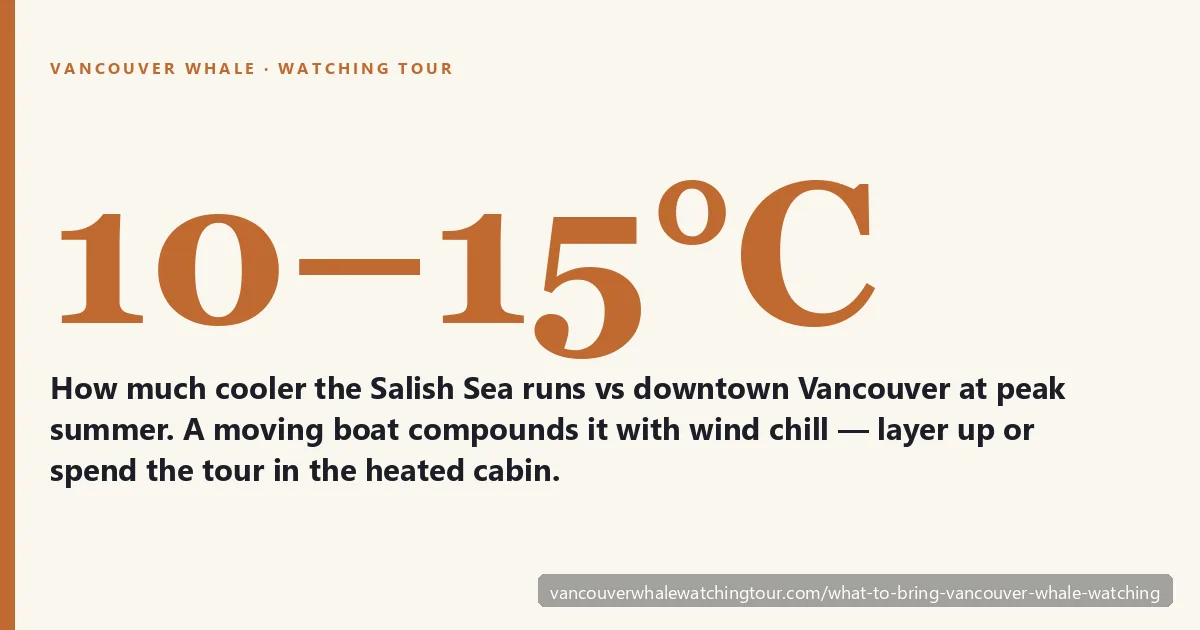
The single biggest mistake first-time Vancouver whale watchers make is dressing for downtown weather instead of Salish Sea weather. Even at the peak of summer, the water off Vancouver runs roughly 10–15°C cooler than the city — and a moving boat compounds that with wind chill. People show up in shorts and T-shirts, then spend the 5-hour covered catamaran tour from Granville Island huddled in the heated cabin trying to warm up.
The Environment Canada and DFO numbers make the gap concrete: in July–August downtown Vancouver Harbour averages a daily high of ~22°C, while Strait of Georgia surface temperature at the Halibut Bank buoy averages 16°C; in April those numbers are 13°C and 9°C. At 25-knot cruise the apparent air temp drops another 2.5–3°C, and any spray adds wet chill on top.
This guide is the full packing list — for both covered catamarans and zodiacs, and for every season the tour operates.
The Essentials (Every Tour, Every Season)
| Item | Why | Notes |
|---|---|---|
| Warm jacket | Wind chill on the water, even in July | Windproof outer layer is the key spec |
| Layers (long-sleeve under) | Easy to adjust for sun/wind | Fleece + base layer works well |
| Closed-toe shoes | Required on all boats — deck safety + warmth | No sandals, no flip-flops |
| Hat that won’t blow off | Beanie in spring/fall, secured ball cap in summer | A baseball cap will go overboard at 20 knots |
| Sunglasses | Strong sun reflected off water — UV is intense | Polarised lenses help spot whales below the surface |
| Sunscreen | Reflected UV from water burns faster than land | SPF 30+, apply before boarding |
| Drinking water | Always good — water purchases on small boats are limited | Reusable bottle preferred |
| Motion sickness tablets (if prone) | See seasickness section below | Take 30–60 min before departure |
These items apply to both boat types. The tour’s own “to bring” list specifies warm clothing and closed-toe shoes as the bare minimum.
What to Wear on a Covered Catamaran
The Prince of Whales catamaran from Granville Island has a heated indoor cabin, so you have a warm refuge if you over- or under-dress. But you’ll spend most of your good wildlife time outside on the viewing decks — and that’s where the wind chill bites.
Recommended layering (summer — June through September):
- Base layer: Long-sleeve T-shirt or thin merino
- Mid layer: Light fleece or sweater
- Outer layer: Windproof jacket (rainproof is a bonus)
- Bottoms: Long pants — leggings or jeans are fine; skip shorts even on a hot day
- Footwear: Closed-toe shoes (trainers or boat shoes work)
- Head: Hat, sunglasses
Spring and fall (April–May, October):
Add a second mid-layer, a beanie instead of a sun hat, and gloves if you run cold. The cabin will be your friend more often.
On a hot summer day in town (25°C+):
Yes, you still need the layers. Pack them in a small backpack and add them after the boat picks up speed. The first 10 minutes will feel like overkill; minute 30 onwards you’ll be grateful.
What to Wear on a Zodiac
Zodiacs are open, fast, and exposed to wind and salt spray. Operators provide full-body waterproof cruiser suits that go over your clothes — that’s the primary outer layer. Your job is to dress warmly underneath the cruiser suit, because cruiser suits block wind and water but don’t add much insulation.
Under the cruiser suit:
- Warm base layer (long-sleeve thermal or merino)
- Mid layer (fleece or sweater)
- Long pants (leggings work; jeans are uncomfortably wet if any spray gets in)
- Wool or synthetic socks — your feet will be coldest
On top of the cruiser suit:
- Hat that secures (a beanie under the cruiser-suit hood works best)
- Polarised sunglasses with a strap
- Gloves if you have them (especially shoulder season)
Skip: down jackets (they don’t recover well from spray), cotton anything (stays cold and wet), expensive cameras you don’t want to splash, and loose hats.
Camera and Photo Gear
On the covered catamaran: A professional photo package is included free — a crew photographer with a long lens shoots wildlife and guests throughout the tour, and you get the photos to download afterwards. This is genuinely useful — it means you can put your phone down and actually watch the whales. If you still want your own shots, a smartphone is fine for sea-lion close-ups and scenery; a mirrorless or DSLR with a 70–200mm or longer lens does well for distant orcas.
On a zodiac: Bring your own camera and a waterproof dry bag to keep it in between sightings. Salt spray is brutal on electronics. A smartphone in a waterproof case is the safest bet for most travellers. If you bring a real camera, expect to clean it thoroughly afterwards. Polarised sunglasses double as a quick filter for spotting whales below the surface — the lenses cut surface glare.
For Families With Kids
If you’re taking kids on the covered catamaran (welcome from age 4+ on most departures):
- Extra layers — kids feel the cold faster
- Snacks — the boat has snacks for purchase, but bringing familiar ones removes a meltdown risk
- Activity backup — the tour provides a Jr. Naturalist kids’ coloring book; bring a small notebook or extra books for the steaming-out portion
- Motion sickness tablets — kids’ formulations exist; pediatric dose if you think there’s any risk
- Change of clothes in your car or hotel — for after the tour, if anyone splashed or spilled
Zodiacs are not recommended for younger kids — most operators require age 8+ and the experience is intense for small children.
Seasickness — Plan Ahead, Don’t Hope
Vancouver whale watching takes you onto the Salish Sea, which is mostly sheltered but can have real chop in spring and fall. If you or anyone in your party gets motion sick:
- Take medication 30–60 minutes before departure — in Canada the dominant OTC option is Gravol (dimenhydrinate), available in tablets, quick-dissolve, and liquid gels at any Shoppers Drug Mart, London Drugs, or grocery pharmacy. Dramamine is the US brand of the same molecule but isn’t widely stocked in Canadian stores; Bonamine/meclizine is largely discontinued here; Stugeron (cinnarizine) is not approved for sale in Canada — don’t expect to find it. Scopolamine patches (Transderm-V) are available OTC in Canada but kept behind the pharmacy counter; ask the pharmacist
- Eat a light meal beforehand — empty stomachs and giant breakfasts both make it worse; aim for toast or oatmeal
- On the catamaran, the indoor cabin is your friend — sit mid-ship near a window and look at the horizon
- Skip the zodiac entirely if you’re seriously prone
Gravol Ginger (standardised ginger root) and Sea-Bands (acupressure wristbands) are non-drowsy alternatives stocked alongside Gravol at the same pharmacies. Don’t try them for the first time on the boat — test at home first.
What NOT to Bring
| Item | Why not |
|---|---|
| Drones | Banned on tour — federal regulations on marine mammals |
| Strollers | No room on either boat type |
| Alcohol | Banned on tour; available before/after on Granville Island |
| Cigarettes / vapes | Banned on tour |
| Loose hats | They will go overboard |
| Cotton clothing as your only warm layer | Cold + wet + slow to dry |
| Expensive cameras without weatherproofing | Salt spray is corrosive |
| High heels or sandals | Closed-toe shoes are required for deck safety |
Quick Pre-Boarding Checklist
Pack the night before; lay it out:
- Warm jacket (windproof)
- Layers underneath
- Long pants
- Closed-toe shoes
- Hat + sunglasses
- Sunscreen applied + extra
- Reusable water bottle (full)
- Backpack to carry it all
- Smartphone with confirmation email saved offline
- Camera + dry bag (if zodiac)
- Motion sickness tablets (if prone)
- Snacks for kids
- Cash for tips (optional, appreciated by crew)
Ready to Book?
The most-reviewed Vancouver whale watching tour — Prince of Whales covered catamaran from Granville Island. 2,362+ guests at 4.8/5. Five hours, three viewing levels, naturalist crew, free professional photo package (so you can leave the long lens at home) — from $186 per person, free cancellation up to 24 hours before. Check availability and book →
Plan Your Trip
Browse Vancouver & Island Whale Tours
Live availability across Vancouver, Victoria and Vancouver Island — instant confirmation and free cancellation.
Spot Orcas in the Salish Sea — Free Photos Included
Join 2,362+ guests who rated this Vancouver whale watching tour 4.8/5. Five hours on a covered Salish-Sea catamaran, three viewing decks, certified naturalist crew, free professional photo package — and free cancellation up to 24 hours before departure.
Check Availability & Book