Victoria Whale Watching Season
When is Victoria whale watching season? Month-by-month guide to orcas, humpbacks and gray whales — best time is May–October, with orcas peaking June–September.
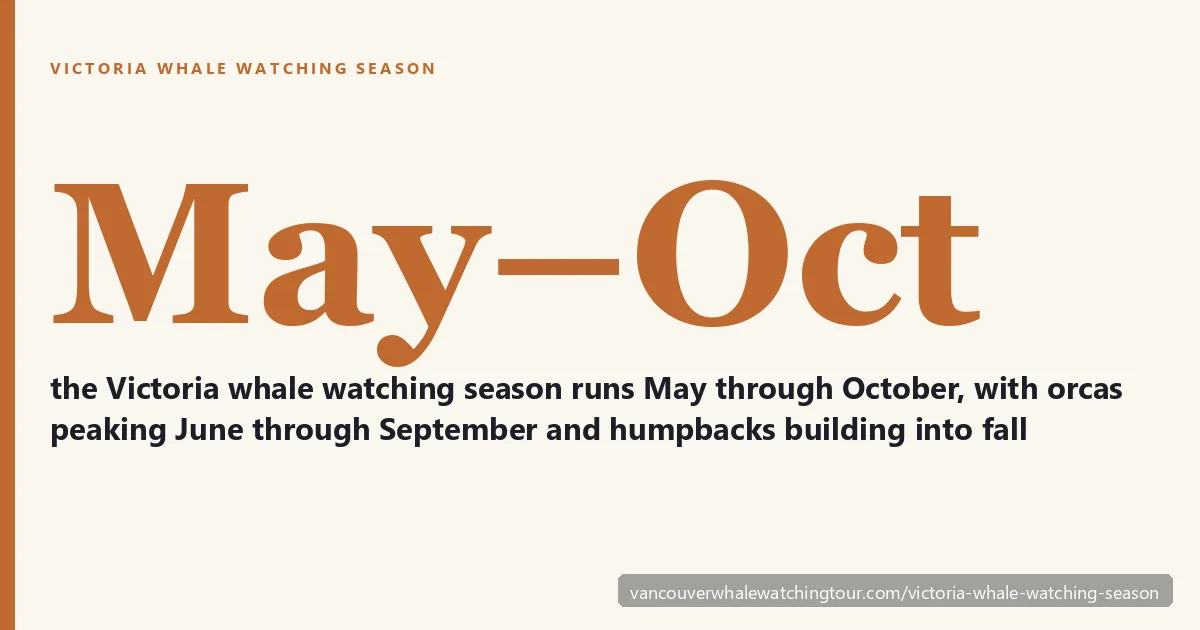
Victoria, on the south tip of Vancouver Island, is the busiest and most accessible whale-watching base in the Pacific Northwest — and its season is longer than most visitors expect. The short answer: the Victoria whale watching season runs roughly May through October, with orcas peaking June through September. But the species you’ll see shifts month by month, so the best time to go depends on which whales you most want to meet.
This guide breaks the Victoria season down month by month — what’s swimming, what the weather’s doing, and which trips make sense when.
Victoria Whale Watching Season at a Glance
| Month | Resident orcas | Bigg’s (transient) orcas | Humpbacks | Gray whales | Operating status |
|---|---|---|---|---|---|
| Jan – Mar | Rare | Year-round | Rare | Spring migration begins | Most operators closed |
| April | Possible | Year-round | First returnees | Northbound migration | Season opening |
| May | Building | Year-round | Increasing | Late migrants | Full operation |
| June | Peak starts | Year-round | Common | — | Peak demand |
| July | Peak | Year-round | Common | — | Peak demand |
| August | Peak | Year-round | Peak | — | Peak demand |
| September | Late peak | Year-round | Peak feeding | — | Strong sightings |
| October | Tailing off | Year-round | Strong | Southbound later | Season tapers |
| Nov – Dec | Rare | Year-round | Heading south | — | Most operators closed |
Two Kinds of Orca — Why Timing Matters
Victoria whale watching is really two stories. The endangered, fish-eating Southern Resident orcas (the J, K and L pods) follow Chinook salmon, so they’re most likely in summer when the big runs push through the Salish Sea — but their numbers are low and protections are tightening. The orca you’re now most likely to see on a Victoria tour is the Bigg’s (transient) orca, a healthy, growing population of mammal-hunters that work these waters year-round. So if you want orca pods specifically, summer is the answer; if you just want to see an orca, the window is far wider than you’d guess.
Month-by-Month
April — Season Opens
Most Victoria operators restart in April. Sightings are real but less dependable than summer. Bigg’s transient orcas are the most reliable orca this month, humpbacks begin returning from their Hawaii and Mexico breeding grounds, and gray whales pass on their northbound migration along the coast. Cooler air and water mean you’ll want serious layers. Free-cancellation policies make April lower-risk than it sounds.
May — Building
Resident-orca sightings start to build as Chinook salmon push into the Salish Sea, and humpback numbers climb through the month. May is a sweet spot: solid wildlife, noticeably fewer crowds than peak summer, and the last of the gray-whale migrants still passing. A genuinely underrated month to visit Victoria.
June — Peak Starts
Southern Resident orcas typically arrive in force as the Fraser River Chinook run peaks, and humpbacks are now common. Long daylight hours make afternoon and evening departures excellent. This is when the most popular Victoria tours start selling out days ahead.
July & August — Full Peak
Resident orcas, humpbacks, Steller and California sea lions, porpoises and bald eagles are all reliably present, and sea conditions are usually at their calmest. Peak-season sighting rates are very high thanks to the operator radio network sharing live whale locations. This is also peak family-travel demand — book one to two weeks ahead, especially for weekend mid-day departures.
September — Late Peak & Humpback Feeding
Resident orcas are often still around, and September brings the year’s best humpback action, with lingering bait-balls drawing them into lunge-feeding behaviour. Weather is still good and crowds thin a little after Labour Day. Many photographers and repeat visitors target September specifically.
October — Tapering
Resident orcas leave as the salmon runs wind down, but humpbacks linger and Bigg’s transients are still around. Weather grows less predictable and some operators reduce schedules. Gray whales begin their southbound migration later in the month. October is the quiet, cheaper last call of the season.
November – March — Closed Season
Most Victoria operators take a winter break. Bigg’s transients, sea lions, porpoises and eagles are still out there, but tour availability is limited. If you’re set on a winter trip, keep your dates flexible and check operator schedules ahead.
What You’ll See — Orcas, Humpbacks, Grays
Victoria sits on the Salish Sea and Juan de Fuca Strait, close to the core summer orca territory around Haro Strait and the San Juan Islands. Bigg’s orcas are the year-round staple; Southern Resident pods are the summer prize; humpbacks have made a remarkable comeback and are common June through October; and gray whales pass on migration in spring and again in late fall. Steller and California sea lions, harbour porpoises and bald eagles round out almost every trip. For the full picture of where these animals concentrate across the island, see our Vancouver Island whale watching guide.
Weather, Daylight & What to Pack
Victoria summers are mild and among the driest in Canada, with long daylight — sunset is around 9:00 PM in late June, so even evening sailings have hours of usable light. Spring and autumn are more variable. The constant: it’s far cooler out on the water than in town, especially when the boat is moving, so dress in warm, windproof layers in every month of the season. Covered vessels have heated cabins; open zodiacs provide cruiser suits.
Getting There in Season
Most Victoria whale watchers come over from mainland Vancouver, and in summer the crossing needs a little planning. The classic route is BC Ferries from Tsawwassen to Swartz Bay (about a 1 hour 35 minute crossing) followed by a short drive into town, while seaplanes connect downtown Vancouver to Victoria’s Inner Harbour in around 35 minutes. In July and August the ferries fill fast on weekends, so book sailings ahead — our sister guide to the Vancouver to Victoria ferry covers the ferry, bus-plus-ferry and floatplane options in detail. If you’d rather skip the overnight, you can also do the whole thing as a Victoria whale watching day trip from Vancouver.
When to Book
Peak season (June–September) regularly fills three to five days ahead, especially weekend mid-day departures. In the shoulder months — April, May, October — one to three days ahead is usually enough. Free cancellation up to 24 hours before departure means there’s little penalty for booking early. Ready to lock in a trip? Compare the covered-vessel, zodiac and north-island options on our Vancouver Island whale watching page, or start from the Vancouver whale watching homepage.
Plan Your Trip
Browse Vancouver & Island Whale Tours
Live availability across Vancouver, Victoria and Vancouver Island — instant confirmation and free cancellation.
Spot Orcas in the Salish Sea — Free Photos Included
Join 2,362+ guests who rated this Vancouver whale watching tour 4.8/5. Five hours on a covered Salish-Sea catamaran, three viewing decks, certified naturalist crew, free professional photo package — and free cancellation up to 24 hours before departure.
Check Availability & Book