Best Time for Vancouver Whale Watching
Month-by-month Vancouver whale watching guide: when to see resident orcas, Bigg's transients, humpbacks, grays, and the peak Salish Sea season.
Vancouver’s whale watching window is wider than most people think — and the species you’ll see shifts dramatically across the season. The headline catamaran tour from Granville Island runs roughly April through October, but the underlying biology — fish runs, mammal migrations, calving cycles — turns each month into a different show on the Salish Sea.
This guide breaks down what’s actually swimming where, by month, so you can pick the trip that matches the wildlife you most want to see.
Vancouver Whale Watching Season at a Glance
| Month | Resident orcas | Bigg’s (transient) orcas | Humpbacks | Grays | Sea lions / porpoises | Operating status |
|---|---|---|---|---|---|---|
| Jan – Mar | Rare | Year-round | Rare | Migrating offshore | Year-round | Most operators closed |
| April | Possible | Year-round | First returnees | Northbound migration | Year-round | Season opens mid-month |
| May | Building | Year-round | Increasing | Late migrants | Year-round | Full operation |
| June | Peak start | Year-round | Common | — | Year-round | Peak demand |
| July | Peak | Year-round | Common | — | Year-round | Peak demand |
| August | Peak | Year-round | Peak | — | Year-round | Peak demand |
| September | Late peak | Year-round | Peak (feeding frenzy) | — | Year-round | Strong sightings |
| October | Tailing off | Year-round | Strong | — | Year-round | Season tapers |
| Nov – Dec | Rare | Year-round | Returning south | — | Year-round | Most operators closed |
Source for daily species presence: site FAQ + tour highlights; seasonal patterns drawn from Pacific Whale Watch Association sightings logs and BC marine-mammal research summaries.
Two Kinds of Orcas — Why It Matters for Timing
Vancouver whale watching is really two different stories depending on which orcas you’re hoping to see.
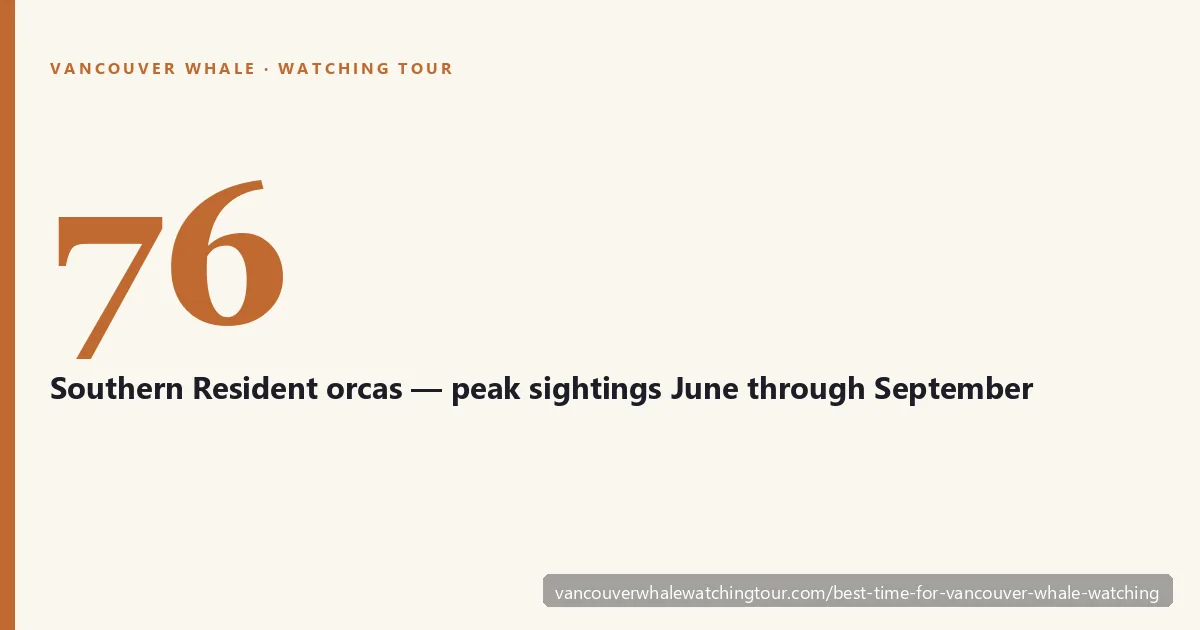
Southern Resident orcas (the famous J, K and L pods) are fish-eaters. They follow Chinook salmon, and the big Chinook runs into the Fraser River and Salish Sea hit late spring and summer. The Fraser-bound Spring/Summer 5.2 Chinook stocks — the SRKW’s preferred prey — peak through the Salish Sea from April through July, with summer 4.1 Chinook adding August abundance. That’s why June through September is the prime resident-orca window. They’re a tightly studied, endangered population of about 76 individuals across three pods (Center for Whale Research, as of May 2026 — counting the February 2026 L129 calf and December 2025 K47 calf), and federal marine-mammal regulations protect them with the strictest approach distances anywhere on the BC coast (see where to see orcas near Vancouver).
Bigg’s (transient) orcas eat marine mammals — harbour seals, porpoises, sea lions, occasionally other whales. They follow prey, not salmon, so they’re present year-round in the Salish Sea. Recent years have actually seen a notable uptick in Bigg’s sightings around Vancouver — they’re the orcas you’re now most likely to see in April–May or October, before and after the resident-orca window.
If you want orca pods specifically, summer is the answer. If you want any orca at all, the season is broader than you’d guess.
Month-by-Month — What’s Actually Swimming
April — Season Opens
Most Vancouver whale watching operators restart around mid-April. Sightings are real but less dependable than summer. Bigg’s transient orcas are the most reliable orca sighting this month. Humpbacks begin returning from their Hawaii/Mexico breeding grounds — the first arrivals usually appear in the Salish Sea in April. Gray whales pass through on northbound migration.
Verdict: Bookable but variable. Free-cancellation policies make it lower-risk than it sounds.
May — Building
Resident orca sightings start to build as Chinook salmon push into the Strait of Georgia. Humpback numbers climb steadily through the month. Cooler air and water temperatures mean you’ll still want serious layers (see what to bring on a Vancouver whale watching tour).
Verdict: Solid month, fewer crowds than peak summer.
June — Peak Starts
Southern Resident orcas typically arrive in force as the Fraser River Chinook run peaks. Humpbacks are now common. Long daylight hours mean afternoon and sunset departures are at their best. This is the start of “sells-out 3–5 days ahead” demand on the covered catamaran tour from Granville Island.
Verdict: First true peak month. Book ahead.
July & August — Full Peak
Resident orcas, humpbacks, Steller and California sea lions, porpoises, and bald eagles are all reliably present. Sea conditions are usually at their calmest. Sighting rates in peak season typically exceed 90% thanks to operator radio networks sharing real-time locations across the Salish Sea. This is also when family travel demand spikes — the catamaran’s heated indoor cabin and snacks make it the obvious pick for kids.
Verdict: The classic Vancouver whale watching experience. Book 1–2 weeks ahead.
September — Late Peak + Humpback Feeding Frenzy
Resident orcas are still around, and September brings the year’s best humpback action. Lingering herring bait-balls plus coho and chum salmon run-up draw humpbacks into lunge-feeding behaviour in the Strait of Georgia — open mouths breaching the surface, bubble-net feeding, full breaches. Photographers and repeat travellers often target September for this reason. Weather is still good; crowds thin a little after Labour Day.
Verdict: Best month for humpback-specific trips. Sleeper pick of the season.
October — Tapering
Resident orcas leave as the salmon runs wind down. Humpbacks linger into October. Weather grows less predictable; some operators reduce schedules. Bigg’s transients are still around. Greys begin southbound migration later in the month.
Verdict: Last call. Cheaper and quieter, more weather risk.
November – March — Closed Season
Most Vancouver whale watching operators take a winter break. The Salish Sea still has Bigg’s transients, sea lions, harbour porpoises, and bald eagles, but tour availability is limited. If you’re determined to go in winter, plan around a flexible date and check operator schedules ahead.
Weather, Daylight & Sea Conditions
Vancouver summers are dry and mild — long daylight hours (sunset around 9:00 PM in late June) mean both morning and afternoon sailings are viable, and even sunset departures have hours of usable light. Spring and fall have more variable weather; the covered catamaran’s heated indoor cabin means rain or chop doesn’t end the trip.
Sea temperatures stay in the mid-teens Celsius even at the peak of summer — the Salish Sea is 10–15°C cooler than downtown Vancouver when the boat is moving, so the warm clothing rule applies all season.
The Prey Calendar — Why Each Month Looks Different
The wildlife shifts month by month because the food shifts month by month. A rough Salish Sea prey calendar — the engine behind everything in the table above:
| Month | Prey event | What it pulls in |
|---|---|---|
| Mar – early Apr | Pacific herring spawn (Strait of Georgia, Howe Sound) | Humpback grouping near herring biomass |
| Apr – Jul | Fraser-bound Spring/Summer 5.2 Chinook | Early Southern Resident sightings |
| Aug | Fraser sockeye peak — 2026 is a dominant cycle year | High prey biomass; supports SRKW + general activity |
| Sep – Oct | Coho run + late chinook + lingering herring bait-balls | Humpback feeding-frenzy peak |
The 2026 Fraser sockeye outlook is roughly 7.5–8 million fish in a dominant cycle line (DFO outlook), meaning August is the standout month for sheer prey volume.
Coast Salish Stewardship of the Salish Sea
The Salish Sea waters where Vancouver whale watching happens — Burrard Inlet, English Bay, Howe Sound (Átl’ka7tsem), the Strait of Georgia — are the unceded ancestral territories of the xʷməθkʷəy̓əm (Musqueam), Sḵwx̱wú7mesh (Squamish), and səlilwətaɬ (Tsleil-Waututh) Nations. Several Coast Salish nations are co-leading current SRKW recovery work alongside DFO Canada — including the Burrard Inlet Action Plan (Tsleil-Waututh), Squamish River estuary Chinook habitat restoration, and the Indigenous Multi-Nation Group that co-develops the annual SRKW management measures. Knowing whose waters you’re a guest in is part of going out responsibly.
When to Book
Peak season (June–September) for the top-rated catamaran from Granville Island regularly fills 3–5 days ahead, especially weekend mid-day departures. Off-season — April, May, October — 1–3 days ahead is usually enough. Free cancellation up to 24 hours before departure means there’s no real penalty for booking early.
For the full booking and logistics breakdown — the boat options, the sightings guarantee, and pricing — see the Vancouver whale watching tour homepage.
Ready to Book?
The covered catamaran from Granville Island runs the full April–October Vancouver whale watching season. Five hours, three viewing levels, certified naturalist crew, free professional photo package — from $186 per person, free cancellation up to 24 hours before. Check availability and book →
Plan Your Trip
Browse Vancouver & Island Whale Tours
Live availability across Vancouver, Victoria and Vancouver Island — instant confirmation and free cancellation.
Spot Orcas in the Salish Sea — Free Photos Included
Join 2,362+ guests who rated this Vancouver whale watching tour 4.8/5. Five hours on a covered Salish-Sea catamaran, three viewing decks, certified naturalist crew, free professional photo package — and free cancellation up to 24 hours before departure.
Check Availability & Book